This guide is for people placing their first wholesale orders: new retailers, boutique owners and online sellers. It explains the practical terms you will meet when you open a wholesale account (minimum orders, payment terms, resale certificates, samples and lead times) and what to ask about each. Every supplier sets its own terms, so treat anything described as “common” here as a starting point for questions, not a rule.
What B2B wholesale means
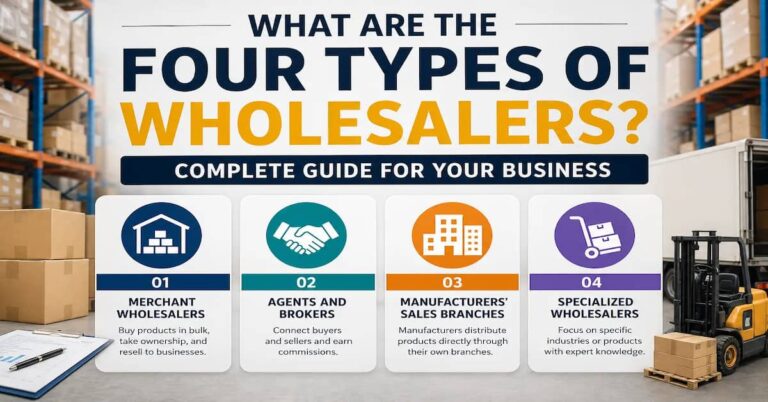
B2B (business-to-business) wholesale is one business selling goods in quantity to another business that will resell them. The seller might be a manufacturer, an importer, a distributor or a closeout company. You buy at a wholesale price, add your costs and margin, and sell to your own customers.
The trade-off compared with buying retail is simple: you get a lower unit price, and in return you accept minimum quantities, paperwork and the risk of holding stock.
Opening a wholesale account
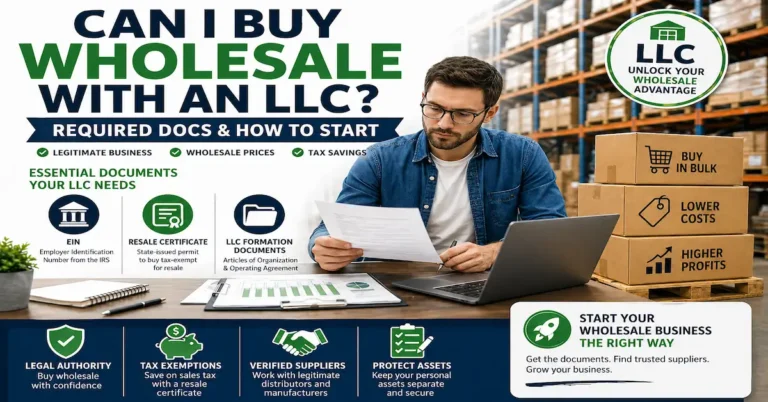
Most wholesalers want to know you are a business before showing prices or selling tax-free. Expect to be asked for some of the following:
- Your legal business name and address
- A federal Employer Identification Number (EIN), which you can get free from the IRS
- A state seller’s permit or resale certificate (see below)
- A website, storefront photo or marketplace seller page showing that you actually sell
Requirements differ a lot. According to its directory listing, Stephanie Imports asks for a valid tax ID and a minimum opening order, while Via Trading lists no business license or minimum order requirement. Always confirm current terms with the supplier.
Resale certificates
In U.S. states with sales tax, goods bought for resale are usually exempt from sales tax at the point of purchase, because tax is collected later when you sell to the end customer. To claim that exemption you give the supplier a resale certificate (the name and form vary by state). You normally need to register with your state’s tax agency first. The SBA’s guide to licenses and permits points to the state agencies involved.
Two practical points: only use a resale certificate for goods you will actually resell, and keep copies, because suppliers are often required to keep them on file too. Rules vary by state, so check with your state tax agency or an accountant.
Minimum order quantities (MOQs)
A minimum can be set in several ways:
- Per order value: a minimum dollar amount for the first order or every order
- Per item: a minimum number of units of one product
- Per case or pack: you buy in the supplier’s case size, often with mixed sizes or colours in a fixed ratio
- No minimum: some suppliers do not set one. Christian Art Gifts, for example, states no minimum order in its listing.
Ask whether the opening minimum differs from the reorder minimum, and whether you can mix products to reach it. For a first order, a lower minimum matters more than a slightly better unit price.
Payment terms
New accounts are usually asked to pay up front, by card or bank transfer, before the order ships. After you have an order history, some suppliers offer trade credit such as “Net 30” (the invoice is due 30 days after the invoice date), usually after a credit application and references.
Questions to ask:
- Which payment methods do you accept, and is there a card surcharge?
- Is payment due before shipping or on delivery?
- Do you offer terms to repeat customers, and what do you need to apply?
- Are there early-payment discounts or late-payment fees?
Samples
Order a sample before your first bulk order whenever you can. Many suppliers charge for samples and shipping; some credit the cost against a later order. Check the sample for quality, sizing, packaging and labelling, and keep it so you can compare it with the bulk delivery.
Lead times and shipping
Lead time is how long it takes from paying to the goods leaving the supplier. In-stock goods from a U.S. warehouse can ship quickly; made-to-order or imported goods take much longer. Ask:
- Is this item in stock, or made or imported to order?
- How long until it ships, and how long is transit?
- Who pays freight, and is there a free-shipping threshold?
- Do you ship by parcel or freight (pallet), and is a loading dock needed for delivery?
Plan reorders around the full lead time plus transit, so you do not run out while waiting for stock.
Working out whether an order makes sense
Before ordering, calculate your landed cost per unit: the unit price plus your share of shipping, any duties, and the cost of preparing the item for sale. Then compare it with what you can realistically sell it for after marketplace and payment fees.
Example (illustrative numbers only): you buy 48 units at $6.00 each ($288). Shipping is $36, so landed cost is $324, or $6.75 per unit. If you plan to sell at $15.00 and your fees are $2.25 per sale, you keep $12.75 per unit, and your gross profit per unit is $6.00 before your other overheads.
Where to find suppliers
Start with a category that matches what you sell, such as general merchandise, apparel and clothing or gifts, and shortlist several suppliers to compare.
First-order checklist
- EIN and state seller’s permit in place; resale certificate ready
- Three or more suppliers shortlisted for the same product type
- Opening minimum, reorder minimum and case packs confirmed
- Payment method and timing confirmed in writing
- Sample ordered and checked
- Lead time, transit time and freight cost confirmed
- Landed cost and margin calculated
- Policy for damaged or short shipments read and saved