Yes. An LLC can buy at wholesale prices from distributors and manufacturers like any other registered business. Most suppliers ask for business documentation, usually an EIN and a resale certificate, to confirm you are buying for resale before they extend wholesale pricing. An LLC also keeps business transactions separate from your personal finances, which protects your personal assets and makes inventory purchases easier to track for tax purposes.
Suppliers check these documents because selling tax-free to a business that will resell the goods is different from selling to a consumer. The paperwork shows them you intend to resell the products rather than use them yourself.
This guide covers the documents you need, how to find legitimate suppliers, how sales tax and income tax apply to wholesale buying, and the mistakes that cost new LLC owners money.
What Documents Does Your LLC Need for Wholesale Purchasing?
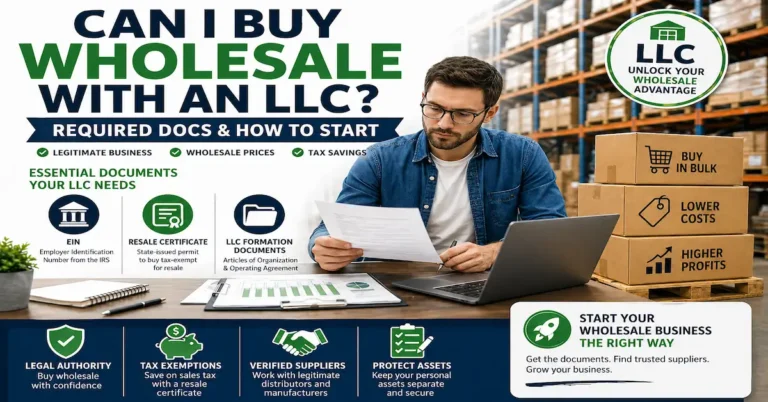
Most wholesale accounts ask for three things: an Employer Identification Number (EIN) from the IRS, a resale certificate backed by your state sales tax registration, and your LLC formation documents. Suppliers check these before granting wholesale pricing and net payment terms.
The EIN is your business tax ID number. The IRS does not charge for an EIN, and if your online application is approved, the EIN is issued immediately (IRS: Get an employer identification number). Wholesalers use this nine-digit number to identify your business on accounts and invoices.
To buy inventory without paying sales tax, you generally register with your state for a sales tax permit (some states call it a seller’s permit or sales tax license) and then give each supplier a resale certificate. The certificate states that you are buying the products to resell them, not to use them. Application steps and processing times vary by state, so check your state revenue department’s website.
Your LLC Articles of Organization (called a Certificate of Formation in some states) are your proof of business formation. Keep copies to hand because suppliers often request them during account setup. Some distributors also ask for your operating agreement to confirm who is authorized to sign for the business.
Pro Tip: Create a digital folder with PDFs of your EIN confirmation letter, sales tax permit, resale certificate, and LLC formation documents. This lets you respond quickly when suppliers request documentation.
How to Obtain Your Federal EIN
Go to IRS.gov and use the online EIN application. Select “Limited Liability Company” as your entity type and answer the questions about your business structure. If the application is approved, the IRS issues the EIN at the end of the online session.
Print or save your EIN confirmation letter as soon as you finish. You will need the number for business bank accounts and supplier applications.
State Resale Certificate Requirements
Each state runs its own system for sales tax registration and resale certificates. Applications usually ask for business details such as your EIN, business address, and the type of products you sell. Some states issue permits online; others process applications and send documents by mail.
The names differ by state (“seller’s permit”, “sales tax permit”, “resale certificate”, “exemption certificate”), and so do the rules on which form to use and whether it expires. Always check your state’s Department of Revenue website for current requirements and processing times.
Where Can LLC Owners Find Legitimate Wholesale Suppliers?
Legitimate wholesale sources include manufacturer direct programs, established distributors, and industry-specific trade platforms. The key is confirming that a supplier asks for business documentation. If they sell to anyone without checking, they are likely operating as retailers with marked-up “wholesale” pricing.
Start with wholesale directories that check supplier credentials and business requirements. These save research time by connecting you with distributors who work with registered businesses. Look for suppliers who ask for your resale certificate during signup; this is a good sign that they run a real wholesale operation.
Trade shows give you direct access to manufacturers. Events like ASD Market Week let you negotiate terms face-to-face and compare multiple suppliers in one location. Bring business cards, your EIN, and your resale certificate to these events.
Industry associations can also be a source of supplier contacts, and some share member directories. Check what membership costs and what it includes before you join.
| Supplier Source | Verification Level | Typical MOQ | Best For |
| Manufacturer Direct | Highest | Highest | Established businesses |
| Regional Distributors | High | Moderate | New LLCs |
| Trade Platforms | Medium | Low to moderate | Testing products |
| Dropship Networks | Low-Medium | Often no minimum | Low-volume testing |
Red Flags That Identify Fake Wholesalers
Be wary of suppliers who charge membership fees just to view products. Real wholesalers earn their money from product sales, not from access fees. Also be careful with any supplier that sells to consumers and businesses through the same checkout with no business verification.
Check if the supplier lists retail prices alongside “wholesale” prices. This tactic inflates the retail number to make wholesale pricing appear discounted. Wholesalers that serve only businesses usually quote wholesale rates only.
How Does LLC Taxation Work for Wholesale Purchases?
Your LLC does not pay sales tax on inventory bought for resale when you give the supplier a valid resale certificate. This exemption applies only to products you intend to sell. Supplies and equipment used to run your business are generally taxable.
By default, an LLC’s profits pass through to the owners’ personal tax returns. Inventory you sell is reported as cost of goods sold (COGS), which reduces taxable income. If you buy $10,000 in inventory and sell it for $18,000, your gross profit is $8,000; other business expenses are deducted from that before tax.
Some LLCs elect to be taxed as an S corporation, which can reduce self-employment tax once profits are high enough. This requires paying yourself a reasonable salary and taking the remaining profit as distributions. Ask a CPA whether the election makes sense for your business.
Selling into other states can create sales tax obligations there. If you store inventory in a state or your sales into it pass that state’s economic nexus threshold, you may have to register, collect, and remit sales tax in that state. Services like TaxJar and Avalara can help track sales by state and file returns.
Pro Tip: Note the expiry or renewal date of your sales tax permit and any resale certificates on file with suppliers. Rules differ by state, and a lapsed registration can mean paying sales tax on wholesale orders until it is renewed.
Documenting Tax-Exempt Purchases
Keep a record of which products were bought tax-exempt under your resale certificate. Include the supplier name, invoice number, product description, and purchase date. States can review these records in an audit to confirm the exemption was used only for goods you resold.
What Are Common LLC Wholesale Buying Mistakes?
New LLC owners often mix personal and business purchases on the same accounts. This creates accounting problems at tax time and can weaken your liability protection. Open a dedicated business bank account and card before placing your first wholesale order.
Another mistake is ordering large quantities to hit volume discounts without checking storage costs and cash flow. A discount loses its value if you are paying for extra warehouse space or tying up cash that could buy faster-moving inventory.
Many LLC owners don’t check supplier references before committing to large orders. Ask for contact details of a few current customers and call them. Ask about delivery reliability, product quality consistency, and how the supplier handles defective merchandise.
Skipping written agreements for net payment terms causes disputes later. Get payment schedules, return policies, defect procedures, and minimum order requirements in writing. Verbal agreements are hard to enforce when shipments arrive damaged or invoices are wrong.
Managing Cash Flow With Wholesale Orders
Calculate your inventory turnover rate before committing to bulk purchases. Divide your annual cost of goods sold by your average inventory value. A higher ratio means stock is selling and funding reorders; a low ratio means cash is tied up in slow-moving stock.
Which Industries Offer the Best Wholesale Opportunities for LLCs?
The automotive wholesale parts sector has steady demand because vehicles need ongoing maintenance. Some suppliers offer net payment terms once you have a payment history with them. This sector tends to reward businesses that specialize in specific vehicle makes or part categories rather than trying to stock everything.
Fashion and clothing suppliers can offer good margins but require trend awareness and seasonal planning. Many clothing businesses focus on a niche, such as sustainable fabrics or plus-size activewear, rather than competing in general apparel. Minimum orders vary by supplier, and overseas manufacturers usually set higher minimums than domestic wholesalers.
Electronics accessories such as phone cases, charging cables, and smart home accessories sell steadily. Suppliers often dropship these items, which removes storage costs while you test demand.
Health and beauty products are consumables, so customers come back to reorder skincare, supplements, and cosmetics. Look for suppliers who offer private labeling; this lets your LLC build its own brand instead of competing on price alone.
Evaluating Product Profitability
Calculate landed cost before committing to a product line. Add the wholesale price, shipping, customs duties, and storage costs, then compare the result with your target selling price. The gap must cover marketing, returns, and payment processing fees and still leave a profit.
How Do State Laws Affect LLC Wholesale Operations?
States set different requirements for wholesale businesses beyond basic LLC formation. California, for example, generally requires a seller’s permit for businesses that sell tangible goods, while Delaware has no state sales tax. Check your home state’s rules through the Secretary of State and Department of Revenue websites.
Some product categories need extra licenses or registrations. Prescription drug wholesale distribution requires state licensing. Many food businesses must register with the FDA and obtain state health permits. Alcohol wholesalers need a federal TTB permit plus a state liquor license.
Interstate sales add complexity. If you sell to customers in other states, track each state’s economic nexus threshold. The 2018 Supreme Court decision in South Dakota v. Wayfair allows states to require out-of-state sellers to collect sales tax once they pass the thresholds each state sets.
Some states tax businesses on gross receipts or revenue rather than net income. Texas, for example, charges a franchise tax on LLCs above a revenue threshold set by the Texas Comptroller. Factor these taxes into your pricing when expanding into new states.
Multi-State Registration Strategies
Consider forming your LLC in the state where you actually operate, whatever the reputation of so-called “business-friendly” states. If you form in Delaware or Nevada but operate elsewhere, you will still pay foreign qualification fees and registered agent costs in your home state. Most small wholesale LLCs save money by registering locally.
Frequently Asked Questions
Do I need an LLC to buy wholesale?
No. You don’t legally need an LLC to access wholesale pricing. Suppliers mainly want proof that you are a registered business buying for resale, such as an EIN and a sales tax permit or resale certificate. A sole proprietor with these registrations can often qualify. An LLC adds liability protection and makes your business look established to suppliers.
How long after forming an LLC can I start buying wholesale?
As soon as you have your EIN, your state sales tax registration, and a resale certificate. An approved online EIN application is issued immediately; state processing times vary. Some suppliers also want a period of business or payment history before offering net payment terms.
What credit score do I need for wholesale accounts?
Suppliers that extend credit often look at business credit reports, such as those from Dun & Bradstreet, as well as or instead of personal credit. New LLCs without business credit history may need to prepay orders or give a personal guarantee. Business credit builds over time as suppliers report your on-time payments.
Can my LLC buy wholesale from international suppliers?
Yes, but you’ll need to handle customs documentation and import duties. Your resale certificate does not exempt you from import duties, only from the sales tax your state would charge. Many importers use a licensed customs broker, especially for larger or regulated shipments.
Does my LLC need insurance to buy wholesale?
General liability insurance isn’t legally required for wholesale purchasing, but some suppliers ask for it. Get quotes from insurers for the coverage you need. Product liability insurance becomes important if you resell items that could cause injury.
Can I use my LLC to buy wholesale and sell retail?
Yes. This is the standard model for most retail businesses. Your resale certificate exempts wholesale purchases from sales tax, then you collect sales tax from your customers where it applies. Your LLC handles both sides of this transaction.
What happens if I use my resale certificate for personal purchases?
Using a resale certificate for personal purchases is misuse of the exemption. States can audit your purchases and impose penalties, which vary by state and can be severe for intentional abuse. Always pay sales tax on items you use yourself, even if you bought them from a wholesale supplier.
How do I find minimum order quantities before contacting suppliers?
Many wholesale directories list MOQs in supplier profiles. If not, email suppliers directly and ask for their minimum order requirements by product category. Expect higher minimums for custom manufacturing and lower minimums for dropshipping arrangements.